_edited.png)
Microplastics and Men's Energy: Why You Feel Drained, and What Most Clinics Never Check

By Fabien Hronec, Certified Health Consultant at Reboot U
THE SHORT ANSWER Yes, everyday plastic may be part of why you feel run down. Plastics carry chemicals that act like hormones, and research links them to lower testosterone and poorer sperm quality. Heat makes it worse, which matters in Florida. Most of it you can lower at home for free, and the rest is worth testing for. |
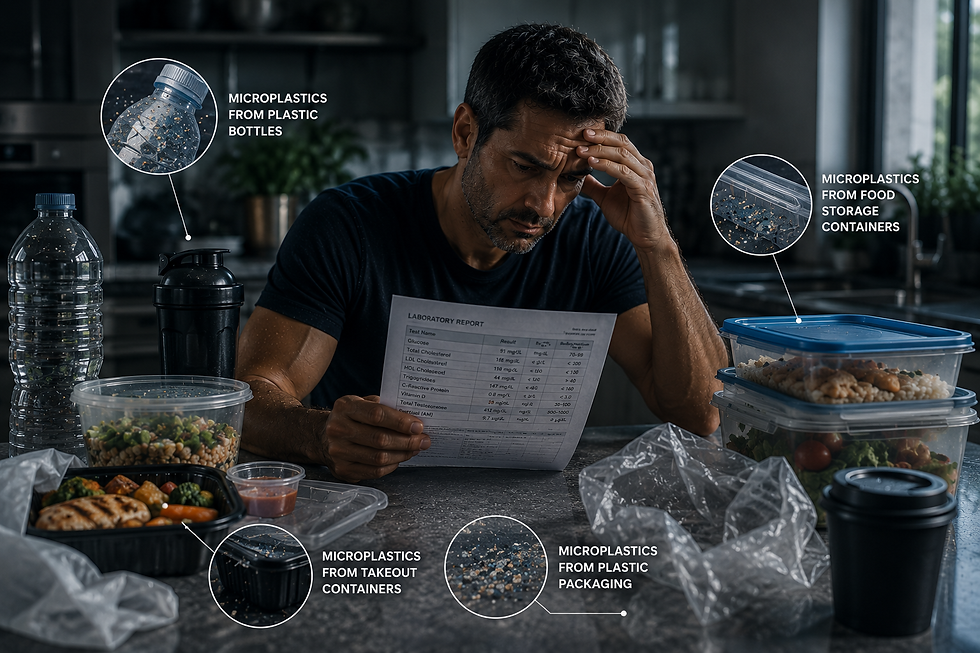
You are not lazy, and you are not just getting old. If you wake up tired, lose your drive by the middle of the afternoon, and feel a step slower than you used to, you already know something is off. Maybe you have been to a doctor. Maybe you were told your labs look fine and to come back next year. That answer never sat right, because you live in your body, and you can feel that something changed.
Here is something most clinics never check: the plastic you touch, heat, and drink from every single day. The science behind it is real, and most of what it points to, you can start changing this afternoon, for free.
Reboot U is a medically-directed regenerative health clinic in Ocala, FL, under Medical Director Dr. Samer Mikhail. We test, not guess. Here is what the research shows.
Can everyday plastic really affect a man's energy and testosterone?
It can contribute. Many plastics carry chemicals called endocrine disruptors that act like hormones in the body and can throw off your own. Research links this exposure to lower testosterone and poorer sperm quality, and in 2024 scientists found microplastics in every human testicle sample they tested.
Microplastics are tiny pieces of plastic, most far smaller than a grain of rice, and they are now found almost everywhere scientists look, including inside the body. The 2024 work came out of the University of New Mexico (Toxicological Sciences, 2024). The chemicals that ride along with these plastics, like BPA and phthalates, are the part that matters for men, because human sperm counts have fallen sharply over the last few decades and this is one of the suspects scientists are taking seriously. If your get up and go got up and went, this is worth taking seriously too.

Why does Florida heat make plastic a bigger problem?
Heat makes plastic release more chemicals and more particles into whatever it touches. A water bottle baking in your truck, a microwaved lunch in a plastic tray, hot coffee in a lined cup: each one pushes more into what you eat and drink. In Ocala summers, that adds up fast.
Research has shown that microwaving food in plastic can release millions of microplastic particles, and that hot liquid sitting in plastic pulls more chemicals out of it (UC San Francisco). Picture the bottle that has been rolling around your hot cup holder since lunch.
That is the same heat we live with here all summer, slowly cooking your water before you drink it.
How do I lower my plastic exposure at home?
Start with what touches you most. Swap hot-car bottles for stainless steel or glass, stop heating food in plastic, and keep warm food and drink out of plastic and plastic-lined cups.
These are small, free changes that lower your daily load right away.

Keep a stainless steel or glass bottle in your truck. Stop drinking from plastic bottles that have sat in the heat.
Never microwave food in plastic. Use glass or ceramic.
Pour hot coffee or food into a real mug or bowl, not a plastic or plastic-lined cup.
Cut back on canned food and drink when you can. Many can linings carry the same chemicals.
Store leftovers in glass, especially anything still warm.
None of that asks much of you. You can start today, and you do not have to buy a thing to begin.
If my labs are normal, why do I still feel off?
Standard labs check a narrow set of markers against broad averages. They can read normal while you still feel drained, because they were never built to see the full picture or what is quietly working against you. Feeling off when the paperwork says fine is real, not in your head.
There is a stubborn myth that this is all in your genes, so why bother. Your genes are not your fate. The field of epigenetics shows that your daily inputs, including the exposures in this article, change how your genes actually behave. Your habits are writing your results right now. So the real question is simple: would you rather keep guessing what your body is telling you, or finally read it?
This is where the search ends. Reboot is medically-directed, under Medical Director Dr. Samer Mikhail, and it brings your history, bloodwork, hair follicle analysis, HRV, and Ondamed mapping into one picture, the picture no single provider had the tools to see.
Most men land here after years of being passed from one office to the next, still without answers. We test, not guess, and your plan is built backward from your own data, not a standard menu. We find what no one else was able to.
Questions men ask about this
Can microplastics lower testosterone in men?
They may contribute. Many plastics carry endocrine disruptors that act like hormones in the body, and research links this exposure to lower testosterone and poorer sperm quality. A 2024 study found microplastics in every human testicle sample tested. Lowering daily exposure is a sensible step.
Does heating plastic release more chemicals?
Yes. Heat makes plastic release more chemicals and more tiny particles into your food and drink. Microwaving food in plastic, hot coffee in lined cups, and water bottles left in a hot car all push more into what you consume. Use glass or ceramic for anything warm.
How do I reduce microplastic exposure at home?
Start with what touches you most. Swap hot-car bottles for stainless or glass, stop heating food in plastic, keep warm food and drink out of plastic, store leftovers in glass, and cut back on canned food and drink. None of it costs much, and all of it lowers your load.
How do I find out what is actually going on inside me?
You test. Reboot U in Ocala, FL is medically-directed and brings together epigenetic hair follicle testing, deep blood panels, HRV, and Ondamed mapping to read what your body is really doing, then builds a plan backward from your data. That is how the guesswork ends.
Where does the search end?
Imagine knowing, for once, exactly what is going on, instead of guessing your way through another year. Steadier energy. Clearer mornings. A body that feels like it is working with you again. That starts with one step: your baseline, under medical direction. No guessing. No one-size shot. Just your blueprint.
Call 352-820-3151 or visit rebootocala.com to book your assessment.
Medical disclaimer
This article is for general education only. It is not medical advice, and it is not a diagnosis or treatment plan. Talk with a qualified provider before making changes to your health routine, especially if you have a medical condition or take medication.
Written by Fabien Hronec, Certified Health Consultant at Reboot U, a medically-directed regenerative health clinic in Ocala, FL, working under Medical Director Dr. Samer Mikhail.
Sources
Microplastics found in human and canine testis tissue. Toxicological Sciences, 2024.
Mixed microplastic exposure and sperm dysfunction, multi-site study. eBioMedicine, 2024. link
Chemicals and microplastics in food packaging. National Center for Health Research. link
How to limit microplastics, with Prof. Tracey Woodruff. UC San Francisco, 2024. link
Comments